8 countries | 15 educational institutions | 75,000+ students | 50,000+ graduates
Visual representation of some academic institutions within the network
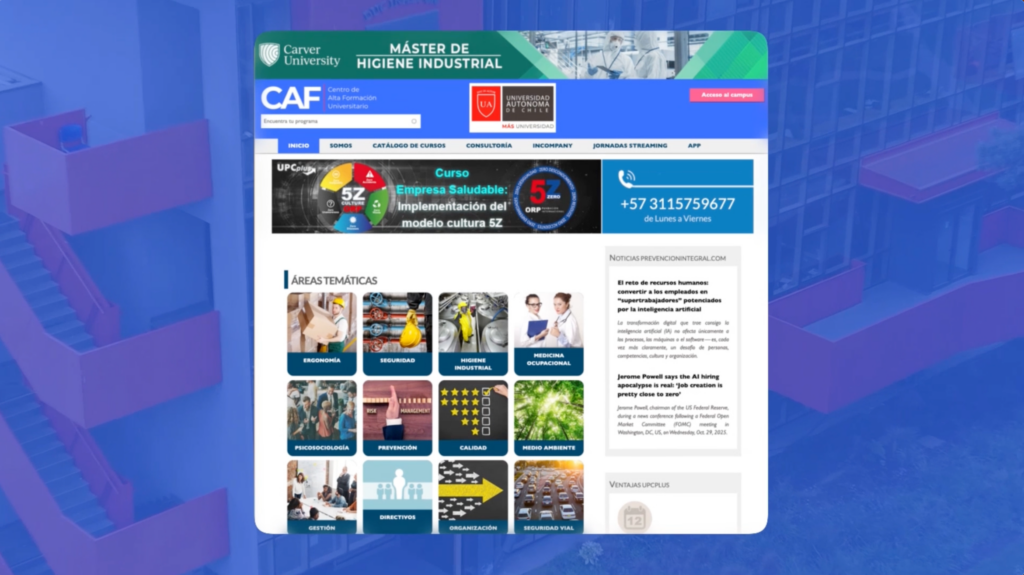
Sabentis Plus+
Más de 500 programas acreditados en SST
🟦🟪⬛ Sabentis Plus+ is our native e-learning platform (corporate campus) designed to train your team with proprietary and/or customized content, multi-device access, and tracking through metrics and reports to measure results and ensure full traceability.
Sabentis: OHS Training Backed by the International Academic Network (GAN)
The Global Academic Network (GAN)
brings together a network of institutions committed to rigorous, accredited training focused on real organizational impact:
8 countries
15 higher education institutions
75,000+ students worldwide
50,000+ graduates
In this context, today we have the privilege of interviewing one of its leading figures: Dr. Gustavo Niklander Ribera.
30-Second Summary
Training only creates impact when it is integrated into real work; learning and execution must coexist as a single process (“merged work and learning”), not as separate activities.
Commitment is not requested—it is designed by enabling time, resources, and routines that make it easy to apply what is learned without friction with daily work.
Upskilling works best when it happens as part of the job itself, through short, frequent practices directly at the workplace.
Leadership makes the difference when training becomes a habitual way of working—observed and reinforced day to day—rather than a one-off initiative.
Without digital tools and real-time data, there is no governance: training only truly takes hold when deployment and early signals are measured.
How to Integrate Training into Daily Work?
Gustavo Niklander:
From my experience in academia—and especially through our ongoing relationship with companies—we have identified very consistent patterns that explain when training truly turns into real practice. This mirrors the goal of effective continuous training inside organisations.
At the university, we do not see training as an end in itself, but as a means to improve performance and employability. This perspective is built and validated day by day: through joint projects with organizations, continuous feedback from both employers and students, and also through spaces such as our Employability Forum, where real market expectations meet the capabilities we are developing.
This ongoing dialogue is particularly valuable because it allows us to adjust, validate, and above all, design training with a clear destination: training conceived to reach the field, be executed under real conditions, and generate visible improvements in practice.
Today, there is also a major opportunity: to stop thinking of training as something separate from work and start designing it as part of the operating system of organizations.
McKinsey describes this as a world where work and learning are fused together:
(“merged work and learning”)
…and argues that the role of learning can evolve into something far more powerful: becoming architects of work design, influencing roles, workflows, and routines so that execution itself reinforces capability development. They even propose shifting the focus from “course completion” to more dynamic, real-time metrics embedded in the flow of work, to see whether skills are actually being applied.
Additionally, when we talk about adoption, the most important lever is often the most concrete one: time.
Upskilling
Many people want to develop themselves, but they face very human barriers—time and cost. That’s why it makes so much sense for companies to enable learning while work is happening: adjusting schedules, facilitating access, and removing friction so training can take place without “competing” with real life.
Another truly important accelerator of effective training is leadership.
In our experience, when leaders model the behaviors they expect to see, the likelihood of success in large-scale change increases significantly. In other words, training is taken seriously and actually applied when the organization turns it into its operating standard, not just “one more activity.”
For this to happen, there are five conditions that must always be considered:
Having an execution-ready context: that is, having the necessary resources, up-to-date procedures, and critical controls in place.
Ensuring short, frequent practice—ideally carried out in the actual workplace through micro-habits.
Developing a brief, regular feedback system with the supervisor.
Having digital tools that enable simple access, generate evidence, and produce reports much faster.
Tracking progress with data and, whenever possible, using alert systems with early signals and short improvement cycles.
When these conditions are in place, training stops “staying in the classroom” and becomes a real continuous-improvement mechanism—one that raises team capabilities and strengthens preventive culture. When learning reaches the shop floor, it strengthens the wider safety culture in the workplace.
That’s why, within GAN, beyond asking “how many hours are we delivering?”, what truly matters to us is this: what conditions are we designing together with organizations so that what is learned can actually be executed the next day, on the work shift, under the real pressure our learners face?
With more than a decade of experience leading institutional development, engagement, and university management, Dr. Niklander has specialized in a key challenge: turning training into applied capability by aligning academia and business to improve performance and employability.
This perspective—focused on standards, evidence, and digital transformation—drives the partnership we are developing at Sabentis together with Universidad Autónoma de Chile and the GAN network: raising the standard of OHS training through the accreditation and certification of a catalog of more than 500 programs within Sabentis Plus+, our e-learning campus natively integrated into Sabentis, to ensure 360° coverage of the OHS ecosystem within organizations.
Additionally, as a milestone of this collaboration, we co-designed the first international MBA in OHS, with academic residencies in the United States, Chile, and Colombia, focused on what truly makes the difference today: digitalization, analytics, and the practical use of AI to automate tasks and accelerate decision-making.
How Do You Create Greater Commitment?
Commitment is not “asked for”; it is designed.
And in OHS, this translates into something very concrete: applying what has been learned must be the easiest, most logical, and most habitual option—not a good intention competing with pressure, lack of time, and limited resources. Applying knowledge in practice is also where the Sabentis Academy focuses its approach.
When the system is well designed, commitment emerges as a consequence. There is an execution-ready context (up-to-date procedures, critical controls, and available tools); learning happens within the flow of work through short, frequent micro-practices; supervision observes and reinforces with brief, regular feedback; and data governs improvement through early signals and short cycles—not bureaucracy.
At its core, people commit when they see purpose (it protects me and my team today), feasibility (I can do it without friction), and coherence (this is an operating standard, not an additional activity).
If we want more commitment, we don’t need more speeches—we need better-designed work so that safe practice becomes the natural option.
SMEs vs. Large Enterprises: What Really Changes When Applying OHS Training?
At the core, the principles don’t change: as we’ve already discussed, training is applied when it is designed to coexist with real work. What does change between an SME and a large enterprise are the system conditions—and therefore the most effective levers for achieving adoption.
In an SME, there is often a huge advantage: proximity. Management is closer to the team, decisions are made quickly, and it’s easier to establish habits because people see each other and correct behaviors in real time. The challenge, on the other hand, is very human: time and resources. That’s why in SMEs, training works best when it is highly practical, short, and focused—centered on critical controls and on two or three micro-practices that are repeated every week on the job. Less “program” and more “routine”: a simple guideline, easy-to-capture evidence, and immediate feedback.
In a large enterprise, almost the opposite happens: there are usually more resources, specialists, and structure, but the main enemy is complexity. Different shifts, sites, contractors, middle management layers… and this is where training risks remaining an “activity” if it doesn’t become an operating standard. The key, then, is governance: integrating training into formal processes, roles, and routines (onboarding, field leadership, planned observations, operational meetings), and measuring not just “attendance,” but real deployment—Is it being applied? How often? Where is it breaking down? What early signals are emerging?
If I had to sum it up:
SMEs:
win through agility and proximity; they need focus, simplicity, and viable micro-habits. Large enterprises: win through resources; they need standardization, consistent leadership, and data to govern at scale. Measuring whether training sticks ties back to tracking the right key safety KPIs.
And in both cases, the key is not to confuse training with transformation: OHS training changes performance when work is designed so that doing the right thing is the easiest and most habitual option during the shift.
FAQ | OHS Training: From Theory to Practice
What is the most common mistake that prevents OHS training from being applied? Treating it as a standalone event rather than as part of daily work.
How can I tell if training is generating real impact? When it shows up in on-the-job behaviors and improves operational indicators—not just attendance or test scores.
What role does the supervisor play in training adoption? Turning what’s been learned into routine: observing, correcting, and reinforcing in the moment.
What type of OHS content is implemented fastest? Content linked to critical controls and practiced through simple, repeatable micro-actions.
What does a digital platform add to OHS training? It enables evidence, tracking, and metrics to govern execution with data.
Warning: foreach() argument must be of type array|object, false given in /var/www/vhosts/sabentis.com/httpdocs/wp-content/themes/generatepress_child/template-parts/content/content-related-posts.php on line 18